High-Velocity Pet Dryers vs Towel Drying: Preventing Deep Undercoat Dampness and Fungal Hotspots
Some links on this site may be affiliate links. As an Amazon Associate, we may earn from qualifying purchases at no extra cost to you.
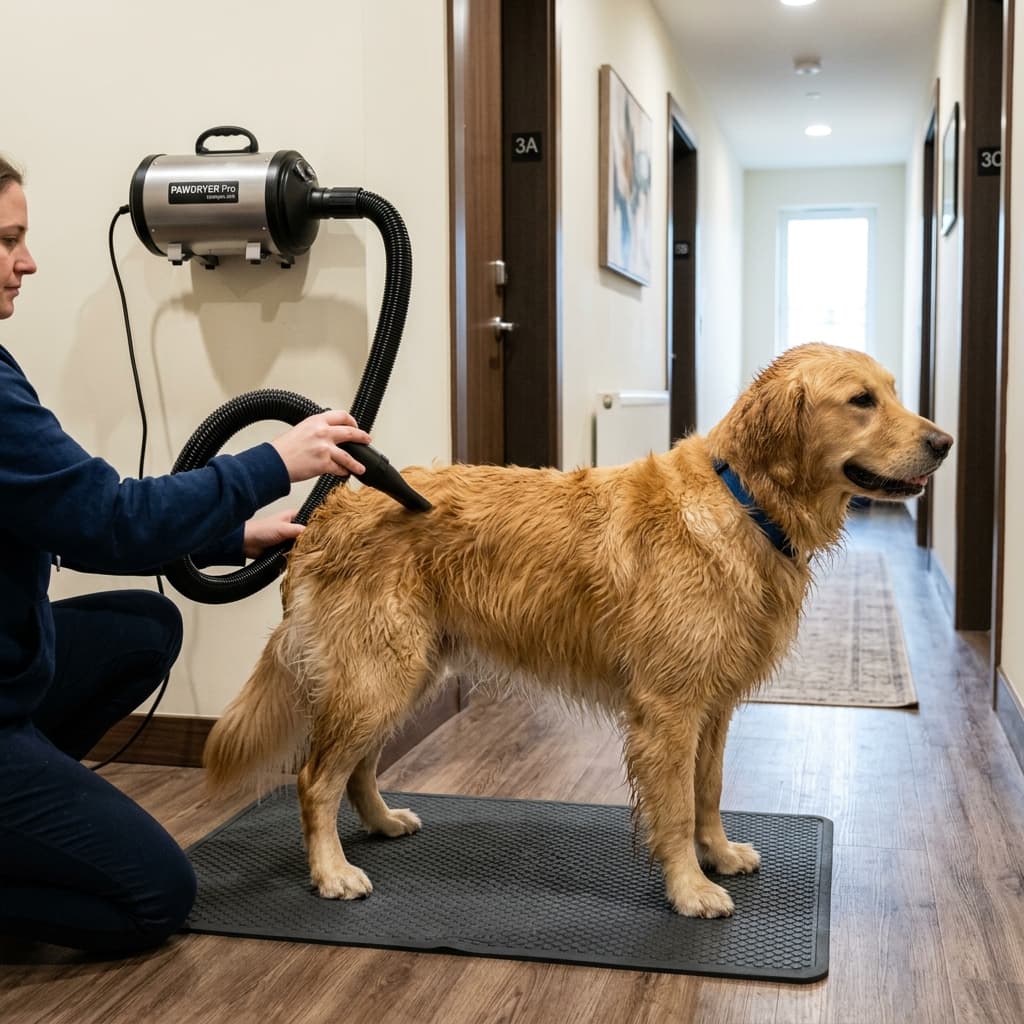
Understanding High-Velocity Pet Dryers vs Towel Drying
If you have ever bathed a Golden Retriever in November and thought they were completely dry after thirty minutes of towel rubbing, press your fingers deep against their skin behind the neck.
Double coats are designed by nature to trap insulating air, which means they also trap moisture with ferocious tenacity. Towel drying only absorbs surface moisture from outer guard hairs, leaving the dense undercoat packed with damp water for up to eighteen hours in cool, sunless winter air. This warm, dark, damp micro-climate is the exact incubator required for acute moist dermatitis (hot spots) and Malassezia yeast overgrowth.
Key Factors when Evaluating High-Velocity Pet Dryers vs Towel Drying
During Shiro's first winter, we gave him a warm bath on a chilly Sunday afternoon. We rubbed him vigorously with four microfiber towels, ran our human hair dryer over his back for twenty minutes until his outer coat felt dry to the touch, and let him nap on his rug. By Tuesday morning, he had chewed a raw, weeping, golf-ball-sized hot spot on his hip. The vet shaved the area and showed us: the skin beneath his outer fur had remained damp for nearly thirty-six hours, triggering an acute bacterial outbreak.
That painful lesson led us to invest in a dedicated high-velocity pet blower. Unlike a human dryer that cooks the coat with dry heat, a pet dryer operates like a focused hurricane, shooting high-speed ambient air that shears water droplets straight off the skin. The first time we used it, sheets of water literally sprayed out of his fur like rain. In twenty minutes, Shiro was bone-dry down to his pink skin, his fur was fluffy and completely free of trapped dander, and he hasn't had a single hot spot since.
- High-velocity dryers use kinetic air velocity rather than high heat, blowing water off the coat without burning sensitive canine skin.
- Standard human hair dryers rely on high thermal heat and weak airflow, damaging delicate guard hairs while leaving undercoat wet.
- Blasting the coat with focused airflow parts the fur down to the skin, instantly revealing hidden ticks, burrs, or early skin redness.
- Drying time for a 30kg double-coated dog drops from four hours of damp shivering to twenty minutes of complete, bone-dry fluff.
Top Picks for High-Velocity Pet Dryers vs Towel Drying
Shelandy 3.2HP Stepless Speed Adjustable Pet Force Dryer
₹₹Best for: The benchmark home grooming blower for double-coated breeds
Features a powerful 3.2 horsepower motor with a stepless dial to adjust air speed from a gentle breeze to a full force blast. Includes four interchangeable styling nozzles and flexible hose.
Pros
- Stepless variable speed dial
- Built-in noise reduction baffles
- Includes wide and narrow concentrator nozzles
Tradeoffs
- Powerful air stream requires desensitizing timid dogs
Flying Pig Pro Super High Velocity Pet Grooming Dryer
₹₹₹Best for: Heavy-duty commercial build with steel casing and flexible heat control
Solid steel outer shell built to last decades. Delivers up to 28,000 feet per minute of airflow with two temperature options (none, low heat) to accelerate winter drying.
Pros
- Indestructible steel construction
- Extremely powerful water-shearing airflow
- Long 10-foot flexible hose
Tradeoffs
- Heavier unit to store in apartment closets
Paw Brothers Variable Speed Dual-Motor Professional Pet Dryer
₹₹₹Best for: Maximum drying power for giant breeds and heavy double-coated shedders
Dual motor configuration providing supreme kinetic airflow velocity. Blasts water and dead undercoat out of dense winter coats in under fifteen minutes.
Pros
- Cuts drying time in half
- Dual motor power
- Excellent for seasonal coat blows
Tradeoffs
- Higher electrical power draw
- Louder motor pitch
Who Will Benefit Most
Select a dryer with a stepless variable-speed dial so you can start on the lowest setting around sensitive zones like ears and muzzle before dialing up to full blast on hips and ruff.
Use a Happy Hoodie (a soft elastic fabric ear muff) over your dog's ears during drying sessions to muffle high-frequency motor noise and keep them relaxed.
When to Consider Alternatives
Never use human hair dryers on their high-heat setting; human dryers can easily heat canine skin above 55°C, causing severe thermal burns through dense fur.
Avoid blasting high-pressure air directly into your dog's eyes, open ear canals, or delicate groin tissue; always maintain a 6-inch safety distance.
Important Considerations Before Buying
- Dry your dog on a non-slip rubber mat or tiled balcony, as high-velocity blowers will blast clouds of water droplets and loose fur into the surrounding air.
- Clean the foam intake filter at the back of the dryer after every session to prevent coarse dog hair from clogging motor cooling fans.
- Keep the nozzle moving constantly in smooth, continuous sweeping strokes rather than holding it stationary on one patch of skin.
- Always use the cool air setting during the final five minutes of drying to close the hair cuticles and leave the coat glossy.
Practical Tips for Daily Use
- Start drying at the rear feet and hips, working forward toward the shoulders so your dog sees that the air stream is harmless.
- Use the flat 'wide duckbill' nozzle for broad sweeps across the ribcage and back, and the round 'concentrator' nozzle to lift dead undercoat.
- Hold the nozzle at a 45-degree angle against the grain of the fur to lift undercoat and blow water forward away from the body.
- Follow up with a wide-toothed greyhound comb immediately after drying to catch any loose hairs that were lifted to the surface.
Final Recommendations on High-Velocity Pet Dryers vs Towel Drying
A high-velocity pet dryer is the single best investment a double-coat dog parent can make for home grooming.
It completely eliminates the nightmare of damp winter hot spots, saves hours of laundry, and leaves Shiro looking like he just stepped out of a championship show ring.
Share this guide
Found this useful? Share it with other dog parents.
Share this guide: